
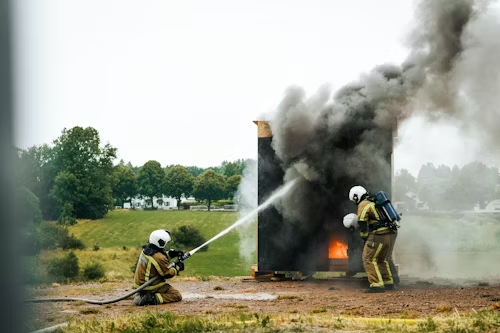
In most workplaces, fire safety is only limited to fire extinguishers hanging on walls. Safety talks and compliance checklists get plenty of attention. But when it comes to workplace fire safety training, there’s no concern, and often it is even considered an afterthought. The question is, why is workplace fire safety training so often overlooked in most workplaces?
To avoid these mistakes, you first need alignment on why fire safety training is important - read 11 key reasons that apply across all industries.
The problem is that most businesses assume fires as rare events. They assume emergency services will always respond on time, quickly enough to minimize damage. So, they don’t bother investing in workplace fire safety training for their staff. Unfortunately, the reality is far from this assumption. Fire accidents in commercial buildings are more common than you may think. The worst part is they spread in seconds, engulfing everything without any prior notice. Such fire incidents cause devastating financial losses and even endanger lives.
So, let’s explore the five most frequent mistakes businesses make in workplace fire safety training, and how you can avoid them to keep your employees safe during any unforeseen fire incidents.
Mistake 1: Treating Fire Training as a One-Time Event
It’s not like fire safety is totally overlooked. But too often, companies only hold a single fire drill or just distribute a handbook on workplace fire safety training. This is it. They assume their job is done and their teams are prepared for an emergency. In reality, workplace fire safety training is not “learn it once and done.” Most employees don’t even open those handbooks, and a single drill can hardly prepare them for a situation where everyone is in panic.
What happens most of the time is that employees forget what they’ve learned if workplace fire safety training is not refreshed periodically. Moreover, companies often hire new employees who may not be familiar with emergency procedures. Each workspace has specific emergency procedures involving fire exits and equipment, but when workspaces and equipment change, they don’t update their fire response planning, leaving employees without any emergency protocols.
That’s why effective workplace fire safety training is an ongoing process. It requires regular drills and refresher courses with scenario-based simulations to ensure employees remain confident under pressure. This continuous approach reinforces knowledge and builds instinctive reactions that can save lives during a real incident.
Mistake 2: Focusing Only on Compliance, Not Preparedness
Compliance is essential with organizations like OSHA putting strict regulations, but that’s not enough. Many organizations design workplace fire safety training around meeting OSHA or local fire code requirements. While compliance is essential, it doesn’t guarantee that your employees are prepared to face a real situation. Checking boxes may create a false sense of security. But if employees are never put in realistic, stressful scenarios, they can never be ready to face something real.
Compliance-driven training usually covers:
- Evacuation routes
- Fire extinguisher locations
- Emergency contacts
But real preparedness requires going further:
- Practicing safe extinguisher use in controlled scenarios
- Training staff to recognize fire risks before they escalate
- Teaching decision-making under pressure
Preparedness means employees won’t just know the rules, they’ll know how to act in the moment when every second counts.
Mistake 3: Using Outdated Tools (Extinguishers and Manuals Only)
The world is rapidly progressing, so why does fire safety remain outdated? Traditional workplace fire safety training often relies on classroom lectures and printed manuals. They might have occasional demonstrations with a fire extinguisher, and that’s all. While these methods are better than nothing, they fail to simulate real fire conditions.
Reading about fire response doesn’t prepare employees for smoke, noise, or even the panic, which is honestly more dangerous than fire itself. Demonstrating a single extinguisher once a year doesn’t train staff in decision-making when their lives are on the line. Moreover, static manuals rarely engage employees, especially in our digital age.
Modern workplace fire safety training incorporates interactive simulations and augmented reality with scenario-based exercises. These tools provide realistic experiences without the dangers of a live fire. This makes training both safer and more effective. Outdated methods may check the compliance box, but they don’t create confident responders.
Mistake 4: Not Training Managers and Team Leaders
Another common mistake is assuming fire safety is the responsibility of all employees equally. There is usually no specific leadership training for managers and supervisors. Employees look up to their superiors in such situations for direction, but when everyone has the same level of training, no one can lead people toward safety.
Panic spreads quickly in emergencies. Evacuation efforts can break down, leading to confusion or injury without clear leadership. Team leaders need:
- Extra training on guiding groups during evacuation
- Communication skills for emergencies
- Authority to make quick, life-saving decisions
When managers and supervisors are properly trained, they become anchors of calm during a crisis. Even well-intentioned employees may hesitate or act unpredictably without that preparation.
Mistake 5: Ignoring Digital Training Innovations
Technology has completely changed workplace fire safety training. Unfortunately, many organizations still rely only on traditional drills and printed handouts. They are ignoring the effectiveness of digital tools, which are inevitably the future.
Modern digital fire training solutions offer:
- Interactive fire simulators that replicate real scenarios without live flames
- Virtual reality (VR) modules that immerse employees in emergency situations
- Online training platforms for consistent access across multiple locations
- Performance tracking to identify areas for improvement
Ignoring these innovations means businesses miss out on safer and more effective training methods that are also engaging. Employees are more likely to retain knowledge when training is interactive and realistic. These are the qualities that digital solutions excel at delivering.
How to Avoid These Mistakes with Pyrosoft Simulators
Avoiding these mistakes starts with rethinking how you approach workplace fire safety training. Checking compliance boxes or running one-off drills is not enough. Companies need to build a culture of readiness through modern and continuous workplace fire safety training methods that are engaging.
That’s where Pyrosoft comes in. Our advanced fire training simulators are designed to give employees safe, hands-on experience in realistic fire scenarios. We combine cutting-edge simulation technology with practical training. So, businesses can ensure their teams are not just compliant, but confident and prepared.
With Pyrosoft, you can:
- Refresh training regularly without costly live burns
- Provide interactive learning experiences that boost retention
- Equip managers and staff with leadership and decision-making skills
- Embrace digital innovation for scalable, effective safety programs
Pyrosoft Inc. helps businesses avoid every one of these mistakes by providing structured, trackable, and engaging fire safety training through digital simulation.
See how Pyrosoft's fire training simulators address each of these common training failures with measurable, engaging, and compliant solutions.
Before your next training session, review the importance of proper fire training - a useful resource to share with HR managers and business owners.
Pyrosoft's fire safety training and support team works alongside your organization to identify these mistakes early and correct them before they become compliance issues.
For a complete solution that prevents all five of these mistakes, explore Pyrosoft's full fire safety services.
One of the most common gaps is training too rarely - our guide on how often fire safety training should be conducted gives clear frequency benchmarks.
Many of these mistakes lead to compliance failures - read what fire safety compliance requirements actually mean for your business under OSHA and NFPA.
Don’t let your workplace fall into the same traps that leave so many businesses unprepared. Invest in smarter, safer fire safety training with Pyrosoft, and give your employees the tools they need to respond effectively when it matters most.