
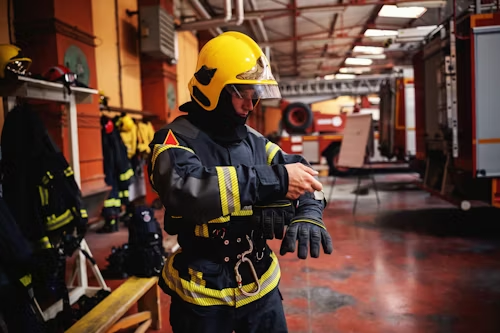
Workplaces all across Canada, whether they are offices, retail shops, factories, or hospitals, face one imminent risk- that of fire. Despite being rare, workplace fires can spread like wildfires in seconds, incurring hundreds of injuries and over $1 billion in damages every year. When such emergencies strike, employees have just moments to act, and whether they can do that or not makes a huge difference to their safety.
If you're evaluating which system to choose, start with our fire training simulators buyer's guide - it covers every major decision factor.
This is why workplace fire safety training has become all the more important. As part of their legal requirements, most businesses make it a point to provide fire extinguishers as well as host regular fire drills. However, Canada Safety Training Centre emphasizes that it is just a myth that organizations are capable of handling fire emergencies. In reality, most employees fall short of taking adequate measures, panic, or misuse equipment when a real fire occurs.
This has paved the way for simulation-based training, an innovative approach to employee fire safety training that is having a transformative effect on how companies prepare their staff. Fire safety simulators work to combine interactive technology with realistic scenarios to enable employees to mold their responses during actual emergencies.
Why Simulation Works Better Than Theory-Only Training
Traditionally, fire safety programs have relied on printed guides, videos, or one-time demonstrations. All these methods are good information sources, but lack one critical component: hands-on practice. In moments of crisis, hesitating or feeling uncertain about what to do next can be a make-or-break factor between a small fire and a major disaster.
Simulation-based training bridges this gap. The training involves digital fire extinguisher training and VR-based systems through which employees can practice how to respond to made-up fire situations without getting exposed to real flames, chemicals, or risk.
Here’s what makes simulation more effective for employee fire safety training than theory-only training:
- Active participation: Employees don’t just passively listen to instructions but actively put them into practice. For instance, they actually handle a training extinguisher; follow the correct steps in a sequence: pull, aim, squeeze, sweep, and finally view the results on screen or in a headset.
- Real-time feedback: The employees can benefit from instant feedback on their responses, such as whether they aimed correctly, used the right distance, or swept too high or low.
- Safe repetition: Live fire drills are once-in-a-while events, whereas simulators offer unlimited practice sessions without additional costs, waste, or hazards.
- Familiar environments: Some systems allow companies to upload images of their actual facilities, so employees can get trained in spaces that resemble their own workplace.
Overall, simulation replaces theory with experience. It aims to go beyond teaching employees what to do and instead practice it until it becomes second nature.
HYPERLINK “https://www.freepik.com/free-ai-image/view-male-engineer-work-engineers-day-celebration_236279059.htm#fromView=search&page=1&position=3&uuid=c1a17f36-55bb-4611-9872-0150ed10528a&query=Workplace+fire+safety+training+using+VR+and+simulation+technology”
The Benefits of Simulated Fire Safety Drills
For Canadian businesses, simulation-based employee fire safety training is not just about convenience. In fact, it offers a myriad of benefits that touch multiple aspects like workplace safety, compliance, and risk management.
1. Builds Confidence Under Pressure
When flames sweep across the kitchen, server room, or factory floor, employees shouldn’t hesitate to act. Simulation training helps build the confidence to do that. By allowing for practice in safe, repetitive scenarios, workers become accustomed to using extinguishers, identifying fire types, and following standard protocols.
2. Develops Muscle Memory
Similar to CPR or first aid, fire response is most effective when actions happen automatically. This is to say that it should all happen instinctively, whether you pull the pin, aim at the base, or simply rush across females. When actions are repeated in a simulated environment, it helps build muscle memory so that employees don’t second-guess but jump straight to action when an actual fire occurs.
3. Promotes Compliance and Documentation
Compliance is equally important for Canadian workplaces. This includes complying with provincial fire codes, the National Fire Code of Canada (NFCC), as well as mandates related to occupational health and safety from the Canadian Centre for Occupational Health and Safety (CCOHS). Simulation systems facilitate compliance by providing automatic recording of training sessions, results, and completion status.
This digital documentation acts as proof of employee fire safety training, which can be critical when inspections and audits take place or after an incident. Instead of relying on sign-in sheets, businesses have detailed performance records at their fingertips.
Workplace Fire Safety Training: A Case Study in Action
To understand the real-world impact of simulation, consider the example of a mid-sized manufacturing company in Ontario that’s facing challenges with traditional fire training. Not only did lectures fail to engage employees, but live-fire drills also added to the costs of getting extinguishers and permits, while management was concerned about keeping up with compliance.
The company adopted a digital fire extinguisher training simulator for its 300 employees, and within six months, the results were measurable:
- Participants found the simulator engaging and practical, which boosted Participation by 70%
- A 40% drop in Training costs was noticed since no extinguishing agents or cleanup were required.
- Audit readiness improved, with the system generating automated compliance reports.
- There was a significant rise in Confidence scores as highlighted by employee feedback surveys.
One safety officer noted, “Earlier, many employees admitted they were not familiar with how an extinguisher worked. They now practice it rigorously until it becomes a natural reaction.” Training also became more efficient, with sessions taking half an hour to complete rather than an hour while achieving their outcomes.
The results of the training spoke for themselves. In the event of a small electrical fire on the shop floor, the employees stayed calm and extinguished it within moments. The most encouraging part is that no injuries or downtime was reported because of the incident. The safety manager acknowledged the role of the recently implemented simulation-based training.
Fire Drills vs. Simulators: Which Is More Effective?
For many businesses, a key question is whether fire drills alone are enough. After all, they’re a legal obligation in most provinces and help employees practice how to evacuate. To be fair, drills are indeed valuable, but they cannot replace hands-on extinguisher training.
Here’s how fire drills and simulators compare:
Fire Drills
Fire drills are the foundation of workplace fire safety. When done right, they
- Inform employees about possible evacuation routes and safe exit procedures.
- Reinforce how to use alarms and communicate emergencies.
- Raise general awareness across the organization so that everyone knows where to go and what to do once outside.
However, drills also come with clear limitations:
- Since there is no hands-on extinguisher practice, employees may know how to evacuate but not how to fight a fire in its early stages.
- Scheduling drills can be disruptive to day-to-day operations, especially in healthcare or manufacturing environments where downtime is costly.
- Over time, employees may start treating drills as something to “get through” or a part of routine formality rather than an opportunity to get meaningful training.
Simulators
In comparison, the focus of digital fire extinguisher training simulators is on building practical response skills. They typically come with these characteristics:
- Employees can avail hands-on practice using extinguishers in a safe, controlled setting.
- They deliver real-time feedback to assess how employees implement the acquired training. For example, whether they utilized the correct sweeping motion, aimed at the base, and maintained the right distance.
- Training is made all the more relevant by offering a range of customizable scenarios, like electrical fires in an office, to grease fires in a cafeteria, to ensure tailored responses based on different fire types and intensity.
- Every session is digitally recorded, which supports compliance audits while giving businesses documented evidence of employee performance.
Still, simulators are not an out-and-out replacement for drills. They too are not without limitations, including:
- An initial investment in equipment is required, though this is often offset by long-term savings compared to live-fire exercises.
- Their core priority is fire response rather than full building evacuation, which means they play a complementary role to drills rather than substitute them completely.
The Best Approach
In practice, businesses are not faced with an either-or choice. The most effective workplace fire safety training programs integrate the best features of both methods for maximum impact.
- Fire drills, first and foremost, prepare employees to evacuate safely without losing time to minimize injuries.
- Simulators equip employees with skills to operate extinguishers with confidence and thus contain small fires before they get worse.
Together, these result in a more comprehensive approach to fire preparedness, encompassing both safe escape and skilled first response.
The ROI of Safety: Reducing Accidents and Liability
On the surface, investing in fire safety training simulators may seem like an additional expense or a burden on your budget. Yet when businesses factor in the long-term savings, it’s clear that the returns on investment are pretty high.
- Lower Rate of Accidents and Damage
Since employees are well-equipped to tackle fires in the early stages, the risk of fires escalating into large-scale incidents is drastically lowered. This would translate into minimum financial losses due to property damage, downtime, or injury.
- Reduced Insurance Premiums
Many insurers offer reward programs for companies that are fully committed to workplace fire safety training programs in letter and spirit. Having digital training records can lead to lower premiums as well as prevent unforeseen increases after an incident.
Learn how businesses maximize the value of their fire safety programs in our post, ‘Ways To Get Your Money’s Worth From Fire Safety Training”.
- Decreased Liability
If an incident occurs and employees were never trained properly, liability risks soar. With documented simulation training, businesses show due diligence, protecting themselves from costly claims.
- Cuts Back Repetitive Costs
Live-fire exercises involve various consumables like extinguishing agents, permits, fuel, along cleanup costs, which are limited to one-time use. Simulators, on the other hand, are reusable with minimal maintenance that can contribute to significant cost savings over time.
5. Improved Employee Retention
A study demonstrated that workplace safety and feeling valued can positively impact employee loyalty. Fostering a strong safety culture not only prevents accidents but also boosts morale, reducing the high costs associated with turnover.
In other words, simulators aren’t just a safety tool; they are a means to financial security, too, and long-term sustainability.
Try Pyrosoft’s Simulator Training Solution
Fire safety shouldn’t be seen as ticking a compliance box. At its core, it’s about creating a more confident workforce that is prepared to tackle whatever challenges may come its way. Being proactive is a crucial ingredient of workplace fire safety, where even seconds of inaction or lagging behind can magnify the risk.
Workplace fire safety training uses the power of simulation to ensure employees are adept at responding, not just in theory, but in practice.
Trusted by organizations across North America, Pyrosoft Inc. delivers Canadian-made, all-in-one digital fire extinguisher training systems. The salient features of our training solutions include;
- Realistic, hands-on training with risk management
- Support compliance with NFCC and CCOHS standards.
- Automatic tracking and documentation of employee performance
- Eliminate waste and emissions to help you achieve sustainability goals.
We are driven to make fire training accessible with flexible options for on-site installation, leasing, or remote demonstrations. Don’t wait for an incident to change; embrace proactive training to protect both your people and keep your business up and running.
Pyrosoft Inc. sits at the intersection of fire safety and simulation technology - delivering training systems that measurably improve preparedness scores and simplify compliance documentation.
Explore Pyrosoft's full range of fire training simulators - including office, industrial, and enterprise models.
For office settings, Pyrosoft's office fire simulation training solution is emissions-free, compact, and deployable in any meeting room.
Pyrosoft's industrial fire simulation platform covers heavy machinery, flammable material, and Class D fire scenarios for high-risk facilities.
The Pyrosoft enterprise simulation platform enables consistent, compliant training at scale - with centralized reporting for multi-site organizations.
Organizations not ready to invest in ownership can rent a simulator for targeted training cycles.
For annual programs, lease a simulator and build simulation training into your recurring safety budget.
For maximum ROI, purchase a simulator outright and train unlimited employees across unlimited sessions.
Pyrosoft's training and support team helps organizations configure compliance reporting and maintain audit-ready records for OSHA and NFPA requirements.
Read Pyrosoft's resource on the importance of simulation in fire training - backed by real performance data from organizations that have made the switch.
Pyrosoft's custom fire scenes feature creates training scenarios based on your actual workplace - improving relevance and knowledge retention.
For organizations wanting a complete training solution, explore Pyrosoft's full fire safety services - from needs assessment to ongoing program management.
To understand exactly what OSHA and NFPA compliance requirements for fire training mean for your business, read our dedicated compliance guide.
Upgrade your fire safety program today. Book a free virtual demo with Pyrosoft and see how simulation can transform your workplace safety training.